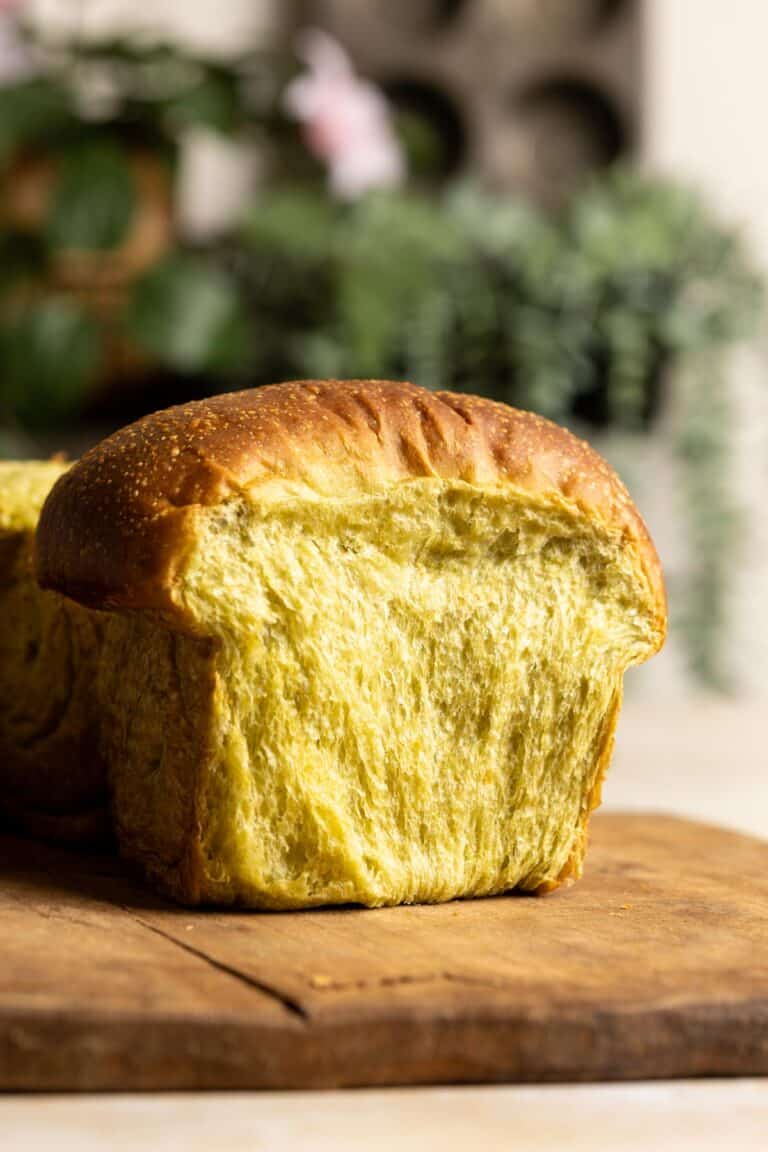
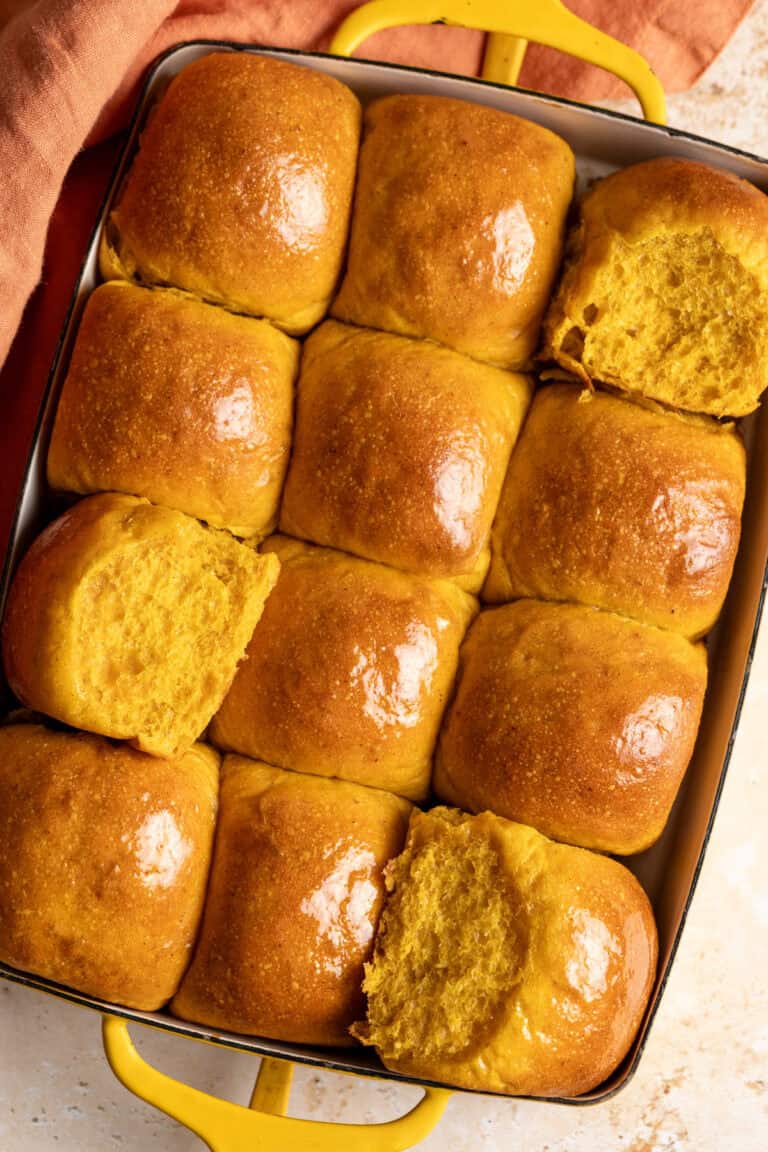
Just like our signature sourdough milk bread, this eggless sourdough milk bread is just as soft and fluffy, with a super tender crumb and a lovely tangy flavor developed from a slow, overnight fermentation. I’ll walk you through step-by-step instructions, along with a sample baking schedule, so you know exactly how to plan your days.

My daughter often tells me about a couple of friends in her class who can’t eat eggs, and how their teacher makes sure they still have special treats so they can enjoy snack time with everyone else. It always sticks with me.
I feel incredibly lucky that my two little ones don’t have any food sensitivities. But if you or your littles avoid eggs, this eggless sourdough milk bread is a wonderful homemade option to have on hand. It is just as soft and flavorful as my original sourdough shokupan.
Ingredients and notes
You only need 5 ingredients for this eggless sourdough milk bread recipe! Two less than my original version.

- I’m using half and half in this loaf, instead of milk like in our signature loaf, to enrich the bread with the added fat content since it will not be enriched with egg and butter. You can buy a carton of half and half or simply mix half whole milk and half heavy whipping cream to create your own half and half.
- I’m using just 30 grams (a smidge more than 2 tablespoons) of sugar, which also helps with yeast activities (from your sourdough starter) since yeast feeds on sugar. It doesn’t make the bread extremely sweet, just enough to balance out the tang from the sourdough starter and long fermentation. You can experiment with increasing the amount of sugar if you prefer your milk bread a little sweeter but I would refrain from reducing the amount of sugar.
- I recommend King Arthur All Purpose Flour for this recipe. There is no need to use bread flour since KA AP flour is already 11.7% protein which is plenty good for bread and a little lower than bread flour to keep the loaf more tender. However, I would stay away from store brand AP flour, most contain only 10% protein which will result in a flimsier loaf with not enough structure.
- Salt is essential to enhance the flavor of your bread. Don’t omit it or the flavor will be flat. I typically use Mortorn kosher salt, so 6 grams of salt is about 1 teaspoon. I promise you this is not a lot, it won’t make your bread super salty.
- This recipe is designed for 100% hydration sourdough starter. I feed mine with a mixture of half rye flour and half bread flour, so you will see that it has brown specs in it. But you can feed your sourdough starter with any type of flour. You just need 100 grams of ripe starter for this recipe. Prepare it, feed it as you normally do, just make sure it is at its peak when you are ready to mix the dough. You can also use a sweet starter to curb tanginess if you prefer.
Sample baking schedule
This baking schedule is designed for a weekend bake that you can start Friday night after work in between dinner and bed time routines, and bake on Saturday afternoon/night. Or if you have a flexible work-from-home schedule, you can start the dough on a week night, and bake it the next day with minimal activities during the day so it doesn’t interfere with your work schedule or even kids’ activity schedule.
Note that this loaf will proof a bit faster than our signature loaf because it is not enriched with egg and butter so the bake time here is 5 pm instead of 7:30 pm (from the signature loaf sample schedule). If I need to bake this on a week day, I would definitely start Day 2 activities a little earlier to move this bake time up away from kids’ pick up time or start it a little later so it falls within the time when I’m home. Feel free to adjust the timeline to fit your own schedule.
| Day 1 | |
| 7:00 AM | Feed your sourdough starter |
| 7:00 PM | Scald half and half + make tangzhong |
| 7:30 PM | Autolyse |
| 8:00 PM | Knead |
| 8:30 PM | Bulk fermentation |
| 9:00 PM | Stretch and fold #1 |
| 9:30 PM | Stretch and fold #2 |
| 10:00 PM | Stretch and fold #3 + cold fermentation |
| Day 2 | |
| 9:00 AM | Finish bulk fermentation at room temp |
| 11:00 AM | Divide dough + shape into balls |
| 11:15 AM | Shape into logs + proof |
| 5:00 PM | Bake |
Make eggless sourdough milk bread with me!
Love seeing each step in photos? Follow along visually as we walk through this recipe step-by-step, take note of the suggested time stamp for each step. Otherwise, you can skip ahead, detailed instructions are in the recipe card below.
Day 1
My sourdough starter typically peaks within 12 hours, so I will make sure to feed it in the morning (around 7-8 am ish) if I know I’m going to start a batch of dough at night (around 7 pm ish). So make sure you build this into your schedule to ensure your starter peaks at the right time.

1. Scald the half and half (7 pm)
Heat the half and half with sugar until the sugar dissolves and the liquid starts simmering. Transfer the mixture to your stand mixer bowl to cool – this will take about 20 minutes or so.

2. Make the tangzhong immediately
Using the same saucepan without washing, cook the half and half with flour to make the tangzhong. Transfer it to a plate and spread into a thin layer to cool.

3. “Autolyse” (7:30 pm)
Mix together flour, salt and the cooled half and half mixture, cover and let this rest for 15-20 minutes.
NOTE: This is closer to a true autolyse compared to our signature sourdough milk bread. Either way, this step will help strengthen the dough and increase extensibility in the stretch-and-fold steps. Without this “autolyse” step, the dough can break easily during stretch-and-fold.

4. Knead the dough (~8 pm)
Add tangzhong and sourdough starter, knead with the dough hook for 20 minutes.

5. Start bulk fermentation (~8:30 pm)
Use a bit of oil on your hand and your bowl scraper to prevent sticking and scrape the dough out of your mixing bowl. Form a smooth ball on a clean countertop or on top of a silicone liner. Oil your mixing bowl before putting the dough back into it. You can also choose to use a new clean bowl for your bulk fermentation.

6. Stretches and folds (9, 9:30, 10 pm)
During bulk fermentation, you will perform 3 sets of stretch-and-fold to add strength to your dough at 30-minute intervals. Once you are finish with your last set, cover and refrigerate overnight.
NOTE: If you’re short on time, I would do 2 at the minimum. And if you forget to set your timer, it’s okay if the time between sets is longer than 30 minutes. I’ve let the dough sit for more than an hour when I need to go pick up kids in between sets. Do what works for your schedule.
Day 2
Remove your dough from the fridge to let it come to room temperature. It likely hasn’t doubled in size yet but should have grown overnight. The time line is flexible here, depending on what I have going on in the morning. I would typically let it sit on the counter for about 2 hours to finish rising while I do my morning chores, take care of the dogs’ needs, make breakfast for kids, etc. Then I would start dividing and shaping. But if you need to go somewhere early, you can divide and shape it right away while the dough is cold. Your proofing period would just be longer.

1. Divide the dough (11 am)
Cut the dough into 3 equal portions. Roll them into smooth balls, cover and let rest for 10-15 minutes to allow the gluten to relax before shaping.
NOTE: The dough shouldn’t be very sticky anymore. You can use just a bit of flour or a bit of oil to keep it from sticking to your surface and hand. I love using a silicone baking mat for this part.

2. Shape into logs (11:15 am)
Shape each ball into a log like so and place them into your loaf pan.

3. Proof the dough (~11:20 am)
Proof the dough for about 6 hours. The dough is ready when it is very puffy, has risen well above the rim of the loaf pan, and a gentle press leaves an indentation that slowly springs back (but not immediately). This dough will proof a little bit faster than our signature loaf since it is not enriched with egg and butter.
NOTE: You can proof your dough inside your oven with the light turn on and a pan of hot water at the bottom of the oven to keep it warm and humid. Or place your loaf pan inside a 6-quart storage bin with a small tin of water as a make-shift proofing box. Proofing time is highly dependent on temperature so make sure to pay attention to visual cues.

4. Bake (5 pm)
Brush half and half or cream wash generously over the surface of your dough and bake at 400°F (205°C) for 7 minutes, then reduce the temperature to 350°F (180°C) and bake for another 20 minutes. Total bake time is about 27 minutes. The internal temperature of your bread should reach 190 – 200°F. Let cool before cutting into it.
NOTE: I’m using egg wash in these photos because I usually reuse the same egg wash for multiple loaves. If you’re using half and half or cream for wash, the top of the bread will still brown but will not be as shiny as these photos. I tested the cream wash with a loaf of matcha sourdough milk bread and it turned out golden and just as perfect.
Storage
- Room temperature: you can store milk bread at room temperature for a couple days. Only slice off whatever you’re planning to eat to keep the moisture within the loaf. Store the bread in a ziploc bag. Since this loaf is homemade with no preservatives, I tend to keep it refrigerated to prevent spoiling.
- Refrigerator: you can keep your milk bread in the fridge for a couple weeks. Again, only slice what you need and keep it in a ziploc bag. It does dry out a bit the longer you store it, but it’s easily revived in the toaster.
- Freezer: for the freezer, I recommend slicing and then freezing. This way you can defrost only what you need when you need. Your bread should last up to 3 months. To preserve the flavor, wrap the loaf in foil as well as plastic and then store in a freezer bag.


Eggless Sourdough Milk Bread
Equipment
- Kitchen scale
- Thermometer
- Stand Mixer
- Saucepan
- Spatulas
- Bowl scraper
- 1-pound loaf pan (8.5” x 4.5”)
Ingredients
Tangzhong
- 20 grams all-purpose flour 11.7% protein
- 100 grams half and half
Bread dough
- 166 grams half and half
- 30 grams granulated sugar
- 260 grams all-purpose flour 11.7% protein
- 6 grams kosher salt
- 100 grams sourdough starter 100% hydration
- Neutral oil for dough handling
Cream wash
- 1 – 2 tablespoon half and half or heavy cream
Instructions
Day 1
- Feed your starter (7 – 8 am) – Discard and feed your starter about 12 hours before you are planning to mix the dough. It should be ready within that time, give or take. Your starter should more than double in size, with bubbles distributed evenly throughout.
- Scald the half and half (7 pm) – Heat 166 grams of half and half with 30 grams of sugar in a small saucepan over medium heat, stirring constantly, until the mixutre is simmering and the sugar has fully dissolved. Take it off the heat, transfer to the stand mixer bowl and let cool.166 grams half and half, 30 grams granulated sugar
- Make the tangzhong – Add 100 grams of half and half to the same saucepan without washing, and sprinkle 20 grams of flour over it. Place over medium heat and stir constantly to incorporate the flour into the milk. Press out any lumps with a spatula and continue cooking until the mixture thickens into a paste. Transfer the tangzhong to a plate and spread into a thin layer to cool.20 grams all-purpose flour, 100 grams half and half
- Autolyse (7:30 pm) – Once the half and half/sugar mixture has cooled to between 80 – 90°F (27 – 32°C), whisk together flour and salt in a separate bowl. Add this to the stand mixer bowl. Use a spatula to mix until all the liquid is absorbed. Cover and let rest for 15 – 20 minutes.260 grams all-purpose flour, 6 grams kosher salt
- Knead the dough (8 pm) – Add the cooled tangzhong and 100 grams of ripe starter to the autolysed dough. Knead with the dough hook on speed 2 for 20 minutes. The dough will still feel tacky but should mostly pull away from the sides of the bowl.100 grams sourdough starter
- Bulk fermentation (8:30 pm) – Oil your hands, a bowl scraper, and your clean countertop. Scrape the dough out and shape it into a ball on the oiled surface. Lightly oil the mixing bowl, then return the dough to the bowl. Cover and place in a warm spot. You will perform 2 – 3 sets of stretch and fold at 30-minute intervals. Set a timer for 30 minutes.Neutral oil for dough handling
- Stretch and fold #1 (9 pm) – With oiled hands, lift the dough from the center. It will stretch as you lift it up and out of the bowl. If it’s too sticky, use your bowl scraper to help release it. Stretch the dough into a long strip and fold in thirds like you’re folding a letter. Turn it 90 degrees, stretch it out into a long strip again and fold in thirds. Place it seam-side down back into the mixing bowl, cover, and set the timer for another 30 minutes.Neutral oil for dough handling
- Stretch and fold #2 (9:30 pm) – Repeat the same process. At minimum, complete 2 sets if short on time.
- Stretch and fold #3 + cold fermentation (10 pm) – Repeat one final set. The dough should feel stronger and more elastic. Cover and refrigerate overnight.
Day 2
- Finish bulk fermentation (9 am) – Remove the dough from the refrigerator. It likely hasn’t doubled yet. Let it come to room temperature and continue rising in a warm spot for about 2 hours.
- Divide (11 am) – Using your bowl scraper, scrape the dough onto a lightly floured surface and divide into 3 portions, approximately 220 grams each. Roll each into a smooth ball. Cover and let rest for about 10-15 minutes.
- Shape (11:15 am) – Take each dough ball, smooth side down, flatten with your hand or roll into a rectangle, fold into thirds like a letter. Flatten again and allow it to stretch lengthwise, but keep the width slightly narrower than your loaf pan. Roll up into a log and place into the loaf pan.
- Proof (11:20 am) – Proof your dough in a warm spot for about 6 hours. I typically use a 15-quart storage bin as my proofing box. You can also proof your dough in the oven with the light turned on and place a pan of hot water at the bottom of the oven to add humidity. The dough is ready when it is very puffy, has risen well above the rim of the loaf pan, and a gentle press leaves an indentation that slowly springs back (but not immediately).
- Preheat the oven (4:30 pm) – Toward the end of proofing, preheat the oven to 400°F (205°C) for at least 30 minutes. If proofing in the oven, remove the dough before preheating.
- Bake (5 pm) – Brush half and half or heavy cream generously over the top of the dough and any exposed sides. Bake at 400°F (205°C) for 7 minutes, then reduce the temperature to 350°F (180°C) and bake for another 20 minutes. The top should be golden brown and the internal temperature should reach 190 – 200°F.1 – 2 tablespoon half and half or heavy cream
- Cool – Let your bread cool in the pan on a wire rack until just warm to the touch before removing it from the pan. Cool completely before slicing.
Notes
- I prefer using oil to prevent dough from sticking to my hand instead of extra flour to avoid adding too much flour to the dough risking a drier loaf.
- On day 2, after fermentation, you shouldn’t need much flour or oil to handle this dough.
- Rising time and proofing time are highly dependent on temperature. Use the time as a general gage but you should pay attention to visual cues to ensure you don’t under or over proof your bread.
- The timeline is a suggestion, feel free to modify it to fit your schedule.
Nutrition
Nutrition information is automatically calculated, so should only be used as an approximation.