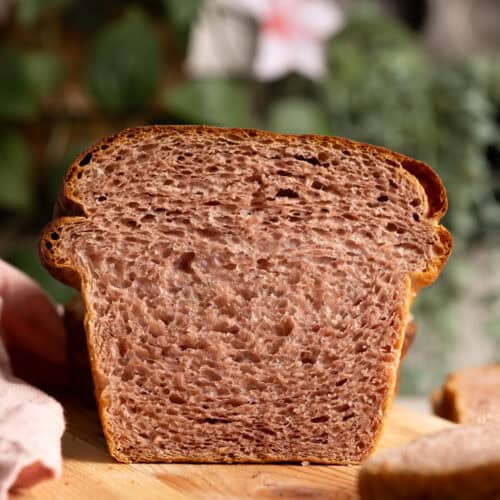
Sourdough Strawberry Milk Bread
This sourdough strawberry milk bread is soft, fluffy, lightly sweet, and packed with strawberry flavor and a naturally pretty pink hue from the freeze-dried strawberries. It’s everything you love about milk bread with a fun strawberry twist.
Equipment
- Immersion Blender
- Kitchen scale
- Thermometer
- Stand Mixer
- Saucepan
- Spatulas
- Bowl scraper
- 1-pound loaf pan (8.5” x 4.5”)
- Silicone mat
- Vinyl gloves
Ingredients
Strawberry sourdough starter
- 10 grams active sourdough starter
- 50 grams strawberries pureed
- 5 grams granulated sugar
- 50 grams bread flour 12.7% protein
Bread dough
- 70 grams whole milk
- 50 grams granulated sugar
- 55 grams unsalted butter sliced into thin pats
- 100 grams strawberries pureed
- 280 grams bread flour 12.7% protein
- 47 grams freeze-dried strawberries processed into powder
- 6 grams kosher salt
- 1 large egg
- All of the strawberry starter
- Neutral oil for dough handling
- Extra milk or egg wash
Instructions
- Make strawberry starter (night before) - Mix all the ingredients for your strawberry starter together before bed time and it should be ready for you in the morning.10 grams active sourdough starter, 50 grams strawberries, 5 grams granulated sugar, 50 grams bread flour
- Prepare the liquid (7 am) - Scald the milk with sugar in a small saucepan over medium heat, stirring constantly, until the milk is simmering and the sugar has fully dissolved. Turn off the heat, add the sliced butter to the hot milk mixture, and stir until completely melted. Add to a stand mixer bowl and stir in the strawberry puree. Let it cool.70 grams whole milk, 50 grams granulated sugar, 55 grams unsalted butter, 100 grams strawberries
- “Autolyse” (7:30 am) - Make sure your liquid mixture is between 80 - 90°F (27 - 32°C), whisk together flour, freeze-dried strawberry powder and salt in a separate bowl and add to the cooled liquid mixture. Use a spatula to mix until all the liquid is absorbed. Cover and let rest for 15 - 20 minutes.280 grams bread flour, 47 grams freeze-dried strawberries, 6 grams kosher salt
- Knead the dough (7:50 am) - Add all of the strawberry starter and a large egg to the “autolysed” dough. Knead with the dough hook on speed 2 for 20 minutes.1 large egg, All of the strawberry starter
- Continue bulk fermentation (8:10 am) - Oil your hands, a bowl scraper, and your clean countertop. Scrape the dough out and shape it into a ball on the oiled surface. Lightly oil the mixing bowl, then return the dough to the bowl. Cover and place in a warm spot. You will perform 3 sets of stretch and fold at 45-minute intervals. Set a timer for 45 minutes.Neutral oil for dough handling
- Stretch and fold #1 (9 am) - With oiled hands, lift the dough from the center. It will stretch as you lift it up and out of the bowl. If it’s too sticky, use your bowl scraper to help release it. Stretch the dough into a long strip and fold in thirds like you’re folding a letter. Turn it 90 degrees, stretch it out into a long strip again and fold in thirds. Place it seam-side down back into the mixing bowl, cover, and set the timer for another 45 minutes.
- Stretch and fold #2 (9:45 am) - Repeat the same process.
- Stretch and fold #3 (10:30 am) - Repeat one final set. The dough should feel stronger and more elastic. It should also have risen and feel puffier. Cover and let it finish bulk fermentation in a warm spot for another 45 mins or longer if needed. The dough is ready when it is puffy, light, airy and more than double in size.
- Divide (11:30 am) - Using your bowl scraper, scrape the dough onto a lightly floured surface and divide into 3 portions, approximately 240 grams each. Roll each into a smooth ball. Cover and let rest for about 10-15 minutes.
- Shape (11:45 am) - Take each dough ball, smooth side down, flatten with your hand or roll into a rectangle, fold into thirds like a letter. Flatten again and allow it to stretch lengthwise, but keep the width slightly narrower than your loaf pan. Roll up into a log and place into the loaf pan.
- Proof (12 pm) - Proof your dough in a warm spot for 4 - 6 hours. I typically use a 15-quart storage bin as my proofing box. You can also proof your dough in the oven with the light turned on and place a pan of hot water at the bottom of the oven to add humidity. The dough is ready when it is very puffy, has risen well above the rim of the loaf pan, and a gentle press leaves an indentation that slowly springs back (but not immediately).
- Preheat the oven (4:30 pm) - Toward the end of proofing, preheat the oven to 400°F (205°C) for at least 30 minutes. If proofing in the oven, remove the dough before preheating.
- Bake (5 pm) - Brush the top of the loaf and any exposed sides with extra milk, half & half or egg wash. Bake at 400°F (205°C) for 7 minutes, then reduce the temperature to 350°F (180°C) and bake for another 21 minutes. The top should be golden brown and the internal temperature should reach ~195°F.Extra milk or egg wash
- Cool - Let your bread cool in the pan on a wire rack until just warm to the touch before removing it from the pan. Cool completely before slicing.
Notes
- This dough is slightly less enriched so it rises a bit faster, take care not to overproof it.
- Rising time and proofing time are highly dependent on temperature. So make sure you watch your dough and not the clock, use my timeline as a general gauge but pay attention to visual cues to ensure you don’t under or over proof your bread.
- I prefer using oil to prevent dough from sticking to my hand instead of extra flour to avoid adding too much flour to the dough risking a drier loaf.
- If you have to use extra flour during rolling, use very sparingly.
- The timeline is a suggestion, feel free to modify it to fit your schedule. You can also cold ferment this dough overnight, bake the next day and split the process into 2 days.
Nutrition
Calories: 179kcal | Carbohydrates: 29g | Protein: 4g | Fat: 5g | Saturated Fat: 3g | Polyunsaturated Fat: 0.4g | Monounsaturated Fat: 1g | Trans Fat: 0.2g | Cholesterol: 26mg | Sodium: 203mg | Potassium: 115mg | Fiber: 1g | Sugar: 8g | Vitamin A: 149IU | Vitamin C: 55mg | Calcium: 18mg | Iron: 1mg
Nutrition information is automatically calculated, so should only be used as an approximation.
So... was this bake worth the ferment?Let us know by rating this recipe.